SpaceSoc’s History: Our 50 Year Mission to the Stars!
Did you know that we used to have our own observatory? Although SpaceSoc was founded in 2016, students stargazing at Bath Uni dates back to at least 1973 when the Astronomical Society (AstroSoc) was founded. In 1985, AstroSoc built an observatory on the far side of where East Extension Car Park is today. AstroSoc ran weekly stargazing sessions from their observatory for many years however, as construction began on the east side of campus, AstroSoc was forced to dismantle the observatory and disband altogether. Soon after the university started offering Physics with Astrophysics courses, student interest in space finally made a resurgence in the form of SpaceSoc. Since then, we have won the Olympus Rover Trials (a national rover building competition) 3 times, bought two our own telescopes and expanded to over 200 members!
AstroSoc (1973-2004):
When AstroSoc was founded in 1973, the university had newly completed its first wave of brutalist buildings, including 2 East where AstroSoc enjoyed stargazing from the rooftop. After starting out with a small 4 inch refracting telescope, they soon upgraded to a respectable 6 inch reflector. As well as astronomy, they organised external speaker talks and trips to British Interplanetary Society (BIS) meetings in Bristol.
Over the next couple of years, the society rapidly expanded their capabilities, culminating in building their own observatory in 1985. Much like today’s Bath Physics Observatory, it was a small wooden shed with a revolving octahedral roof. AstroSoc worked hard to frequently maintain and upgrade it with concrete legs in 1994 and a motorised mount for their 10 inch reflecting telescope in 1997.
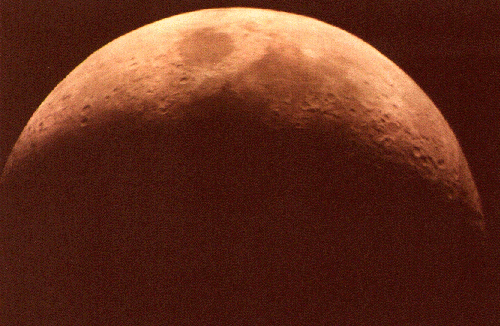
1995 film photo of the Moon.
Outside of the observatory, AstroSoc hosted a variety of events including: trips to Greenwich observatory and London Planetarium, a portable planetarium show in 4E and guest lectures about extra-terrestrial life. For International Space Year, AstroSoc stepped up to the challenge of competing in an international rocket building competition, run by ANSTJ (now known as Planète Sciences). They collaborated with other UKSEDS members around the country before launching their rocket in France. Thanks to AstroSoc’s forward thinking, they quickly adapted to new technologies. In 1995, they created their own website and even gave a PowerPoint presentation on a CRT monitor for the 1997 freshers fair!
Despite their success, AstroSoc remained a small and niche society. Throughout the late 90s and early 00s, they struggled to attract enough committee members to continue. In 2002, tragedy stuck as strong winds damaged the revolving roof of the observatory, rendering it immobile. As if that wasn't enough, the encroaching construction of Marlborough Court, Solsbury Court and East Car Park worsened light pollution and made the observatory inaccessible. Under mounting pressure, AstroSoc was forced to give up the observatory and disband in 2004.
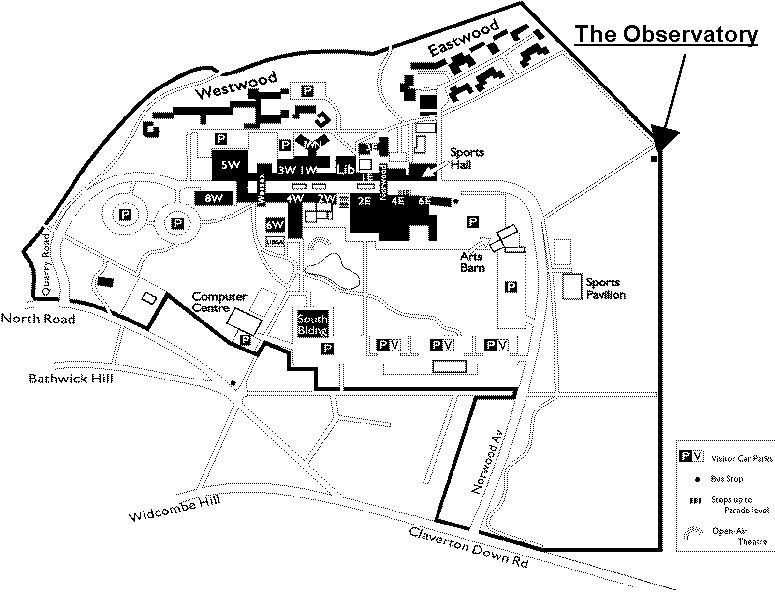
1995 campus map of AstroSoc observatory.
The 1995 AstroSoc logo is based on NASA's STS-67 mission patch.
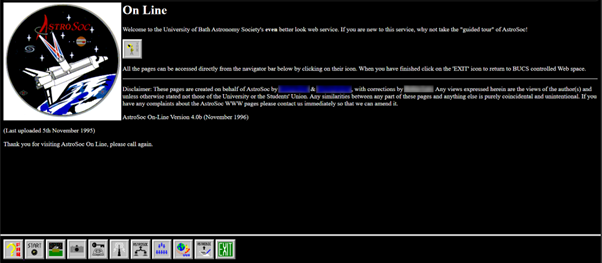
Screenshot of the 1997 AstroSoc website.
The Hiatus Period (2004-2016):
In the immediate aftermath of AstroSoc’s dissolution, the physics department was quick to claim the telescopes and equipment which proved to be essential for several research projects. Sadly, little attempt was made to revive AstroSoc because their events fit well under PhySoc.
In 2009, the short lived BathSEDS was formed as a branch of UKSEDS and later merged with the Bath Electrical and Mechanical Engineering Society (BEAMES). BEAMES however, decided to disaffiliate itself with UKSEDS after only 2 years.
SpaceSoc (2016-present):
On the 2nd of April 2016, students once again tried to create a society dedicated to space. They created SpaceSoc to bring together enthusiastic students from all departments. Their founding principles ensured a wide-reaching appeal by splitting the society into three branches - casual, theory and practical. Although much has changed since then, our goal to bring together students interested in all aspects of space persists today.
Later that year, on the 10th of July, SpaceSoc usurped PhySoc as Bath Uni’s official UKSEDS branch which allowed them to enter the new Olympus Rover Trials competition. Their team, called Aqua Lunae, built a rover from scratch and achieved an honourable mention. On the 21st of June 2017, in preparation of next year’s competition, Aqua Lunae rebranded itself as Team Bath Roving (TBRo) which we know and love today! Coincidentally, Bath Rocket Team (BRT) was independently formed around the same time.
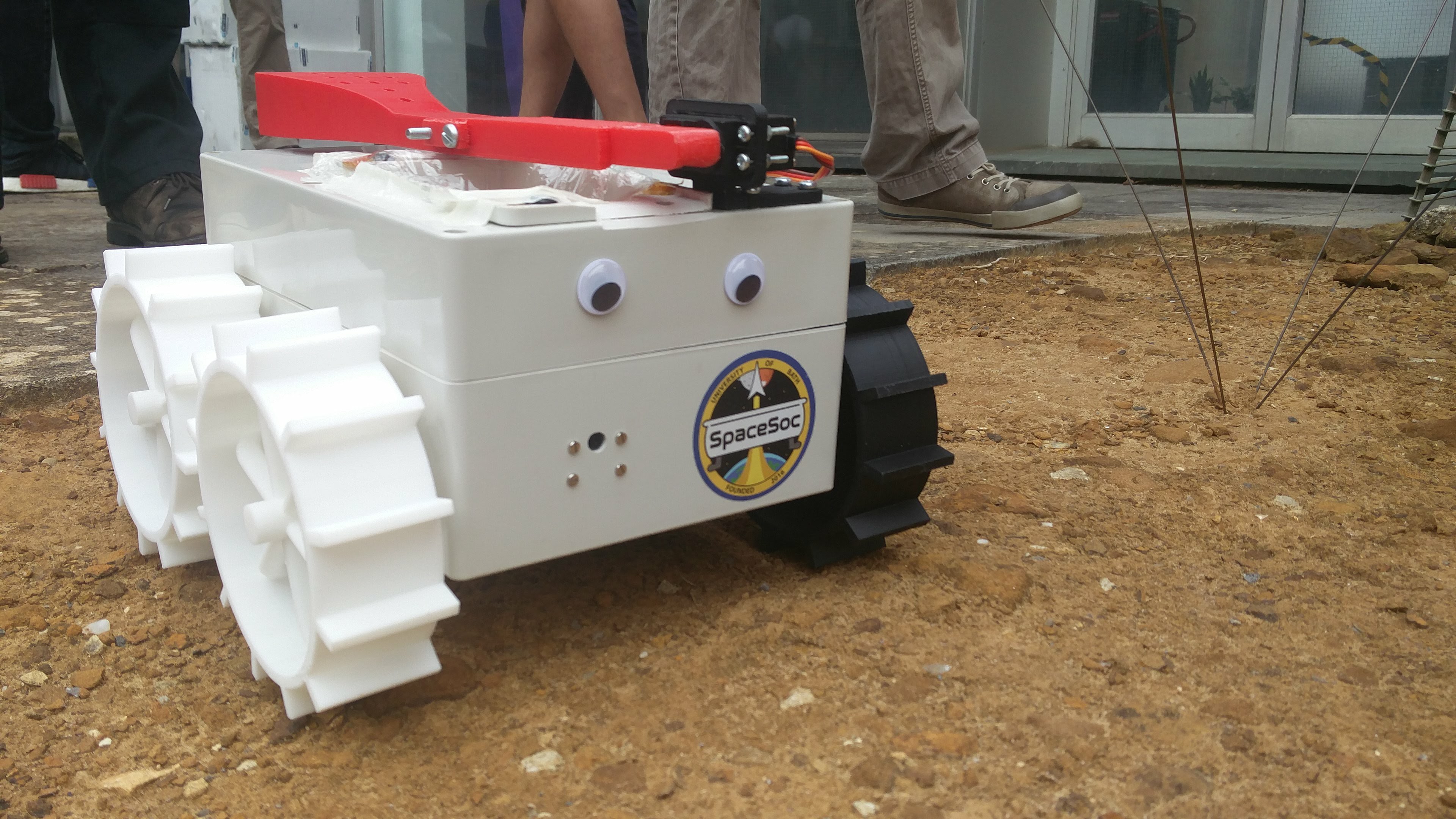
2017 rover at the competition.
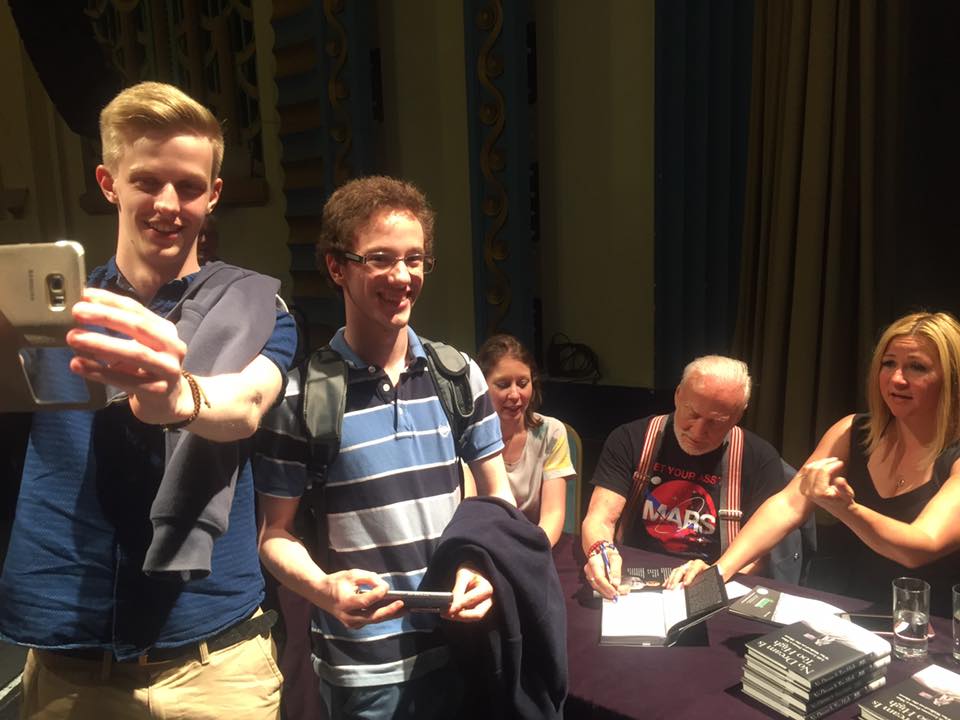
In 2016, two SpaceSoc members met Buzz Aldrin at a book signing event.
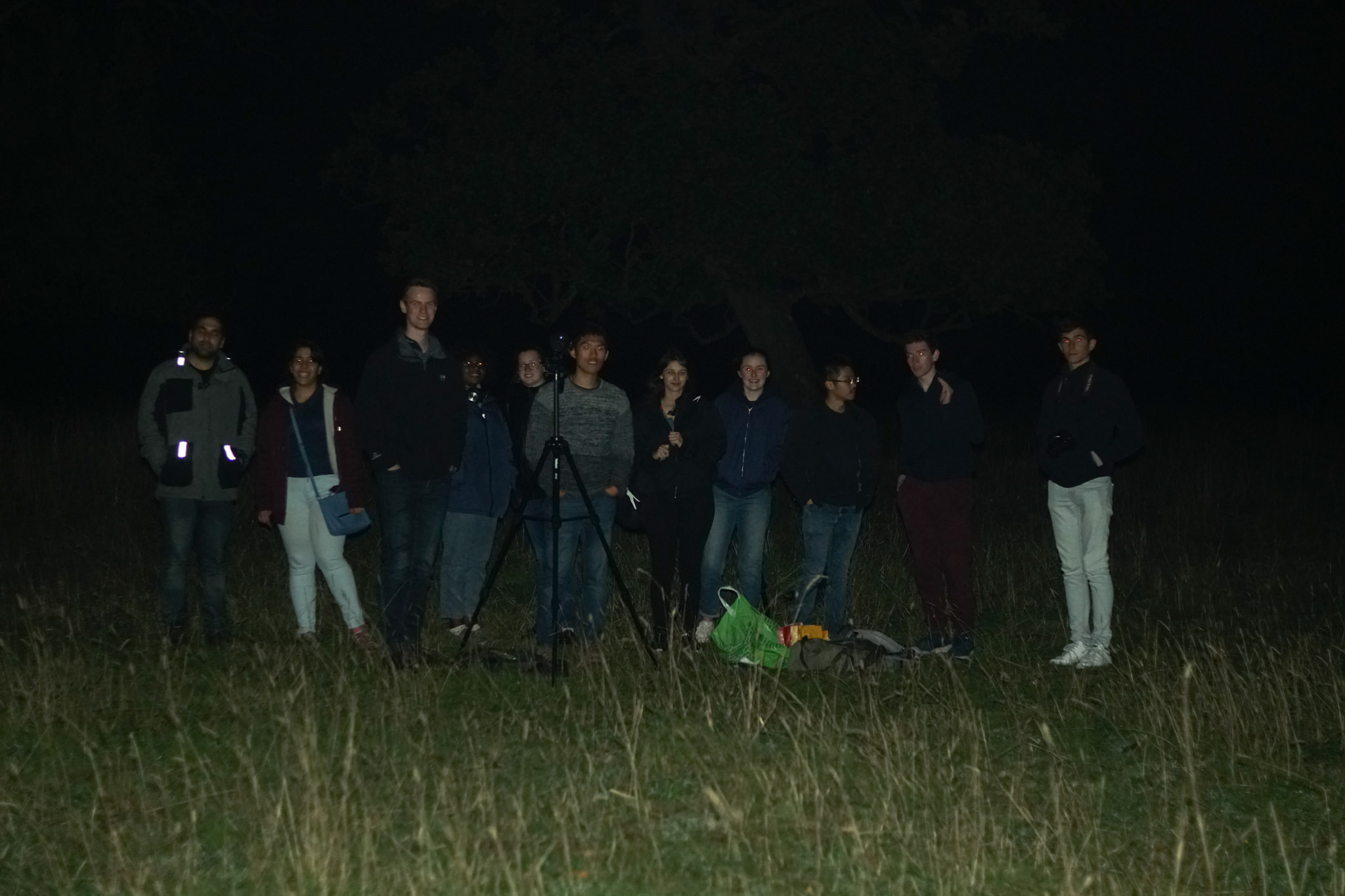
2018 stargazing social.
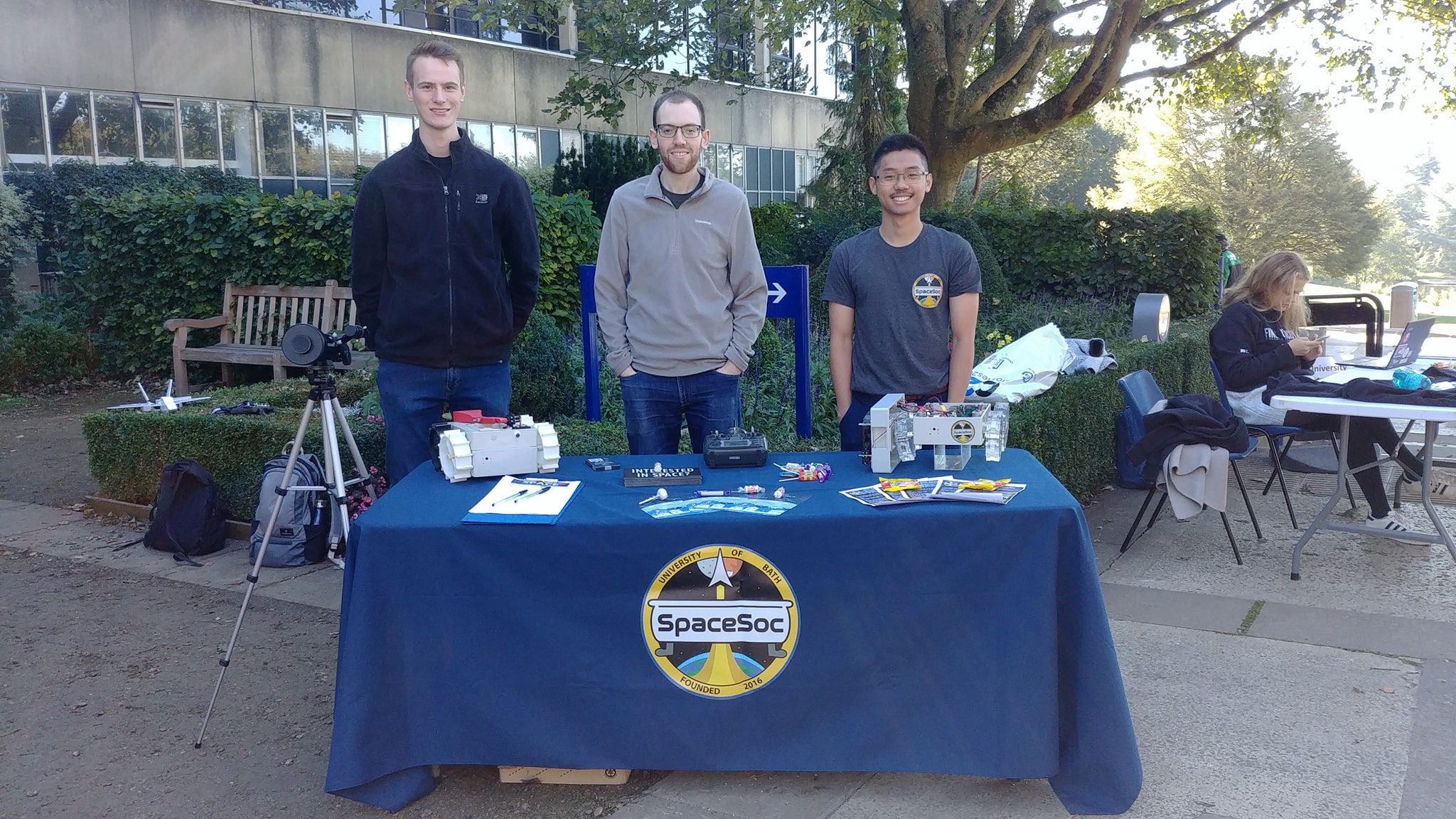
2018 Groups Day.
After TBRo secured its first victory in 2019, it seemed like nothing could stop SpaceSoc! And yet, a global disaster was about to strike.
The Covid-19 pandemic was devastating for both SpaceSoc and the wider university community. Construction of the TBRo rover was stopped, the Olympus Rover Trials went online, the SpaceSoc twitter account went silent, stargazing was put on hold and contact with the Herschel Museum and Bath Astronomers was severed. For the first time, all SU membership fees were dropped, and lectures were recorded online. It soon became clear that some changes made during the pandemic were permanent and societies needed to adapt.
Once the pandemic had subsided, SpaceSoc eagerly resumed its activities. In 2022, SpaceSoc bought a second telescope for stargazing events and reestablished connections with Bath Astronomers. Around the same time, we created the Kerbal League which challenged members in a rocket simulation game. TBRo returned to the Olympus Rover Trials and won the 2022 and 2023 competitions. Yearning for more, TBRo made the difficult decision to leave SpaceSoc in favour of Engineering and Design student competition teams so that they could get better access to lab space and sponsorships.
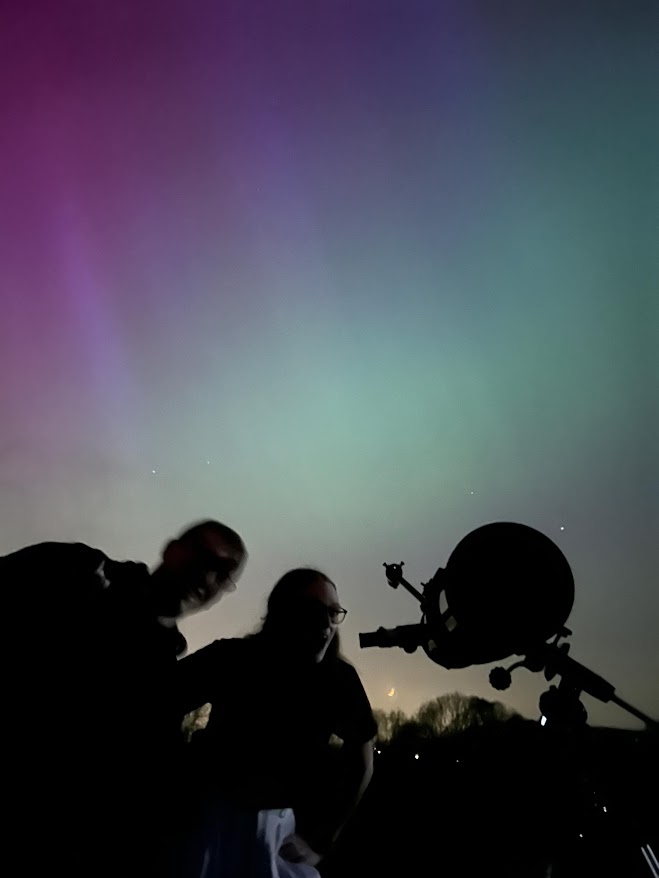
2024 aurora stargazing.
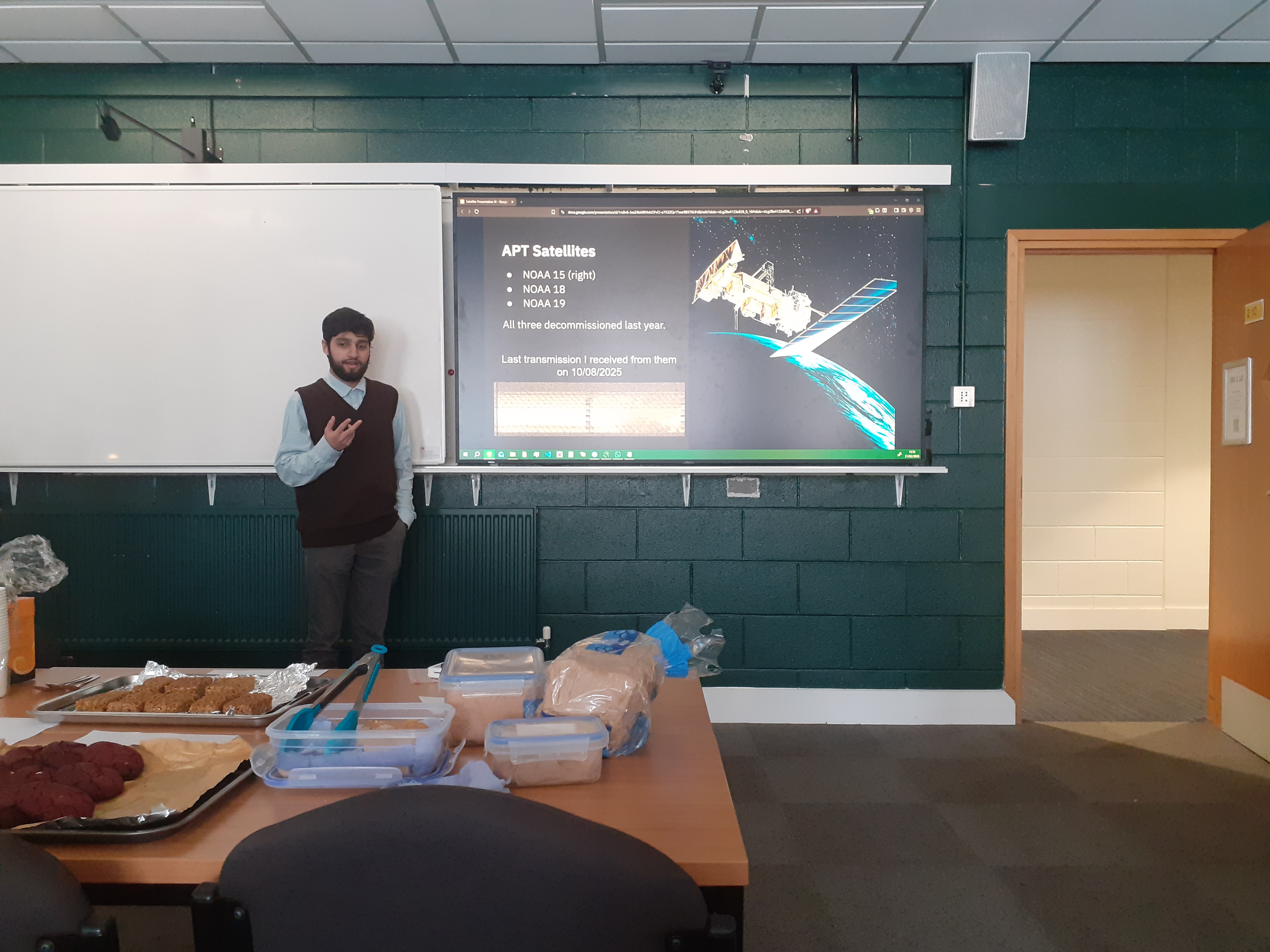
2026 Space after SpaceSoc conference.
More recently, SpaceSoc was amazed by a rare and beautiful aurora, lighting up Bath’s skys in 2024. To celebrate SpaceSoc’s 10th anniversary, several alumni spoke about their early career progression at the ‘Space after SpaceSoc’ conference.